
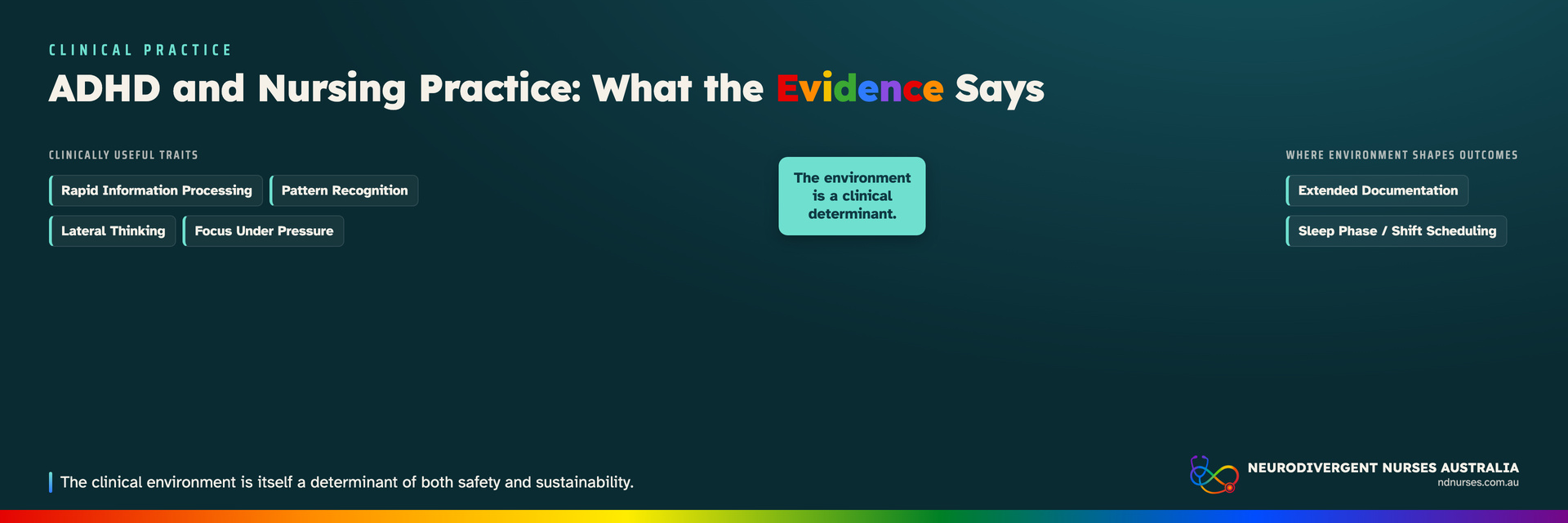
ADHD and Nursing Practice: What the Evidence Says
Nurses with ADHD bring genuine strengths to clinical practice — rapid information processing, pattern recognition under pressure, lateral thinking in complex presentations, and the methodical adaptive practice many build across years of working out what is reliable for them. ADHD is one of the neurocognitive profiles within the neurodivergent spectrum: a difference in brain development that affects attention regulation, impulse control, and executive function (the mental skills involved in planning, organising, and completing tasks). A pooled prevalence estimate from an umbrella review of international studies puts adult ADHD at approximately 3.1% (Ayano et al., 2023), and is present in the nursing workforce in proportions consistent with the broader population. Despite this, ADHD in nursing has received considerably less research attention than dyslexia or autism, and the evidence base — while growing — remains limited in some areas.
Traits Some Nurses With ADHD Describe as Clinically Useful
Qualitative research, including an interview study with nurses who have ADHD and/or autism (Hedlund & Jordal, 2024), suggests some nurses with ADHD describe certain ADHD-associated traits as an asset in specific clinical contexts. The capacity to sustain intense focus during high-acuity or emergency situations, rapid information processing, and pattern recognition in complex presentations are traits some nurses describe as working in their favour in fast-paced environments. Lateral thinking and comfort with variable, unpredictable work have also been described as useful in acute settings.
These accounts are meaningful and worth taking seriously. They are also largely based on self-reported experience rather than large-scale measurable outcomes, and individual variation within the ADHD population is substantial. What functions as a strength in one environment may create significant friction in another.
Where the Challenges Are — and Why Environment Matters
ADHD-associated differences in sustained attention, working memory, and executive function can create real challenges in nursing: managing extended documentation requirements, tracking multiple parallel tasks across a long shift, and maintaining routine procedural consistency under fatigue. These are documented across studies with nurses and nursing students who have ADHD (Pohlmann & Hill, 2025; Hedlund & Jordal, 2024). The degree of difficulty is substantially shaped by the workplace. Shift length, documentation system design, staffing levels, and whether reasonable adjustments are in place all determine whether ADHD-associated traits create significant barriers or manageable differences. The clinical environment is itself a determinant of both safety and sustainability. The adaptive labour of working around poor environmental design is structurally misplaced when it falls on the individual nurse.
Sleep differences are also relevant. Research indicates that delayed sleep phase — where the body clock runs later than conventional schedules — is significantly more common among people with ADHD than in the general population, with implications for early morning shift scheduling and fatigue management. Awareness of this among employers and roster managers can make a practical difference.
ADHD does not automatically constitute an impairment under the Australian Health Practitioner Regulation Agency (AHPRA) registration standards. The relevant question is whether a nurse’s capacity to practise is detrimentally affected — not whether they have a diagnosis. Nurses with ADHD are not required to disclose their diagnosis to AHPRA or their employer as a matter of course.
The disclosure decisions that come with an ADHD diagnosis in a nursing context are addressed in Neurodivergent Nurses and Disclosure. How structural factors like staffing and shift work compound ADHD-related challenges is covered in Burnout and Moral Injury in Neurodivergent Nurses.
References
Ayano, G., Tsegay, L., Gizachew, Y., Necho, M., Yohannes, K., Abraha, M., Demelash, S., Anbesaw, T., & Alati, R. (2023). Prevalence of attention deficit hyperactivity disorder in adults: Umbrella review of evidence generated across the globe. Psychiatry Research, 328, 115449. https://doi.org/10.1016/j.psychres.2023.115449
Hedlund, Å., & Jordal, M. (2024). Feeling like an untapped resource: Experiences of working life among nurses with ADHD and/or autism: An interview study. International Journal of Nursing Studies, 158, 104857. https://doi.org/10.1016/j.ijnurstu.2024.104857
Pohlmann, M. R., & Hill, P. L. (2025). Scoping review of neurodiversity in nursing workplaces. Research in Neurodiversity, 1, 100007. https://doi.org/10.1016/j.rin.2025.100007
Disability Discrimination Act 1992 (Cth).
Health Practitioner Regulation National Law (as in force in each state and territory).
This post contains general information only and does not constitute legal, medical, or professional advice. Information is accurate to the best of the author’s knowledge at the time of publication. For advice specific to your situation, please consult an appropriately qualified professional.