
Intersectionality and Neurodivergent Nurses: When Identity Layers Compound Workforce Barriers
Neurodivergent nurses (including those with neurocognitive profiles such as autism, ADHD, dyslexia, dyspraxia, and dyscalculia) bring deep strengths to Australian healthcare: pattern recognition, sustained attention, empathy grounded in lived experience, and methodical adaptive practice built across years of working in systems that often recognised only part of how they think. The conditions under which those strengths can be expressed are not uniform. A nurse with ADHD in a supportive workplace with good occupational health support is in a fundamentally different situation than a First Nations nurse, an internationally qualified nurse, or an LGBTQIA+ nurse in the same role. Intersectionality, the analytical framework developed by legal scholar Kimberlé Crenshaw to describe how overlapping systems of disadvantage interact and compound, has not yet been well integrated into workforce inclusion strategies in Australian healthcare.
How Intersectionality Shapes the Neurodivergent Nurse Experience
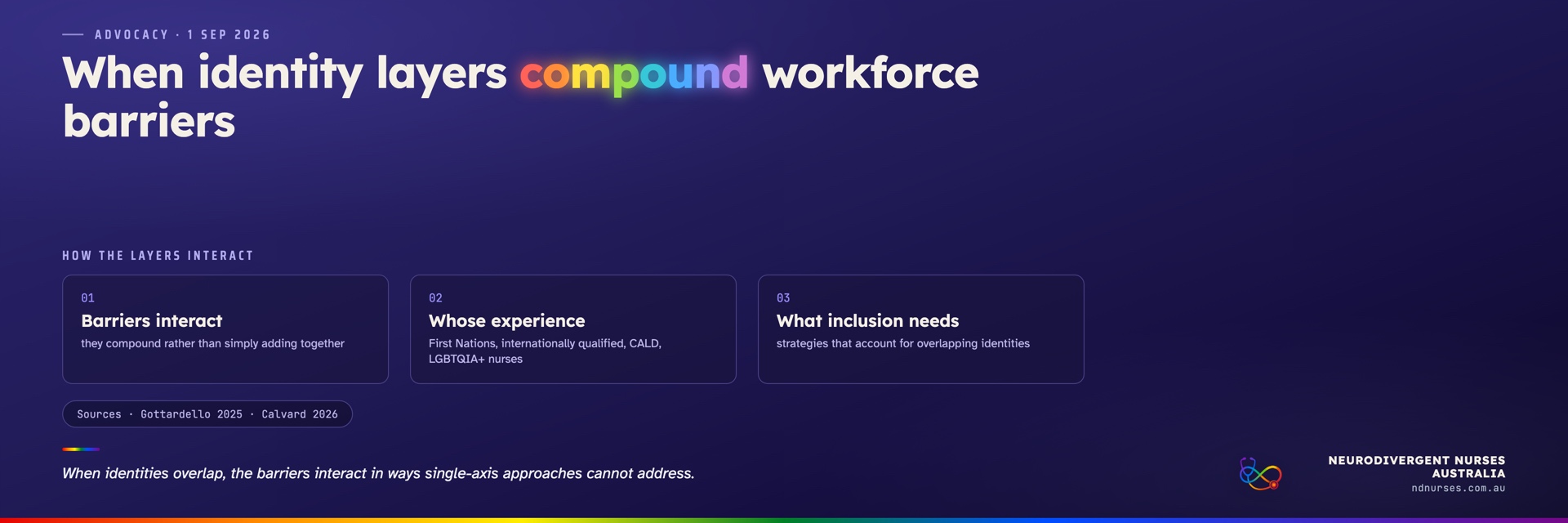
The Australian nursing workforce includes substantial numbers of internationally qualified nurses, First Nations nurses, and practitioners from culturally and linguistically diverse backgrounds. When a neurodivergent nurse also holds one or more of these identities, the barriers to disclosure, adjustment, and career progression do not simply add together; they interact in ways that single-axis approaches cannot address. An internationally qualified nurse with dyslexia completing the Australian Health Practitioner Regulation Agency (AHPRA) bridging program faces standard assessment demands alongside language and cultural expectations built around a neurotypical, English-as-first-language norm. An autistic First Nations nurse may encounter workplace cultures where both Indigenous identity and the way they communicate are misread as disengagement.
Research on neurodivergent employees from ethnic minority backgrounds has documented how intersecting stereotypes shape workplace experiences and access to professional recognition (Gottardello et al., 2025). The underlying dynamic is consistent internationally and directly relevant to Australian experience (Calvard et al., 2026). The specifics differ between countries, but the underlying dynamic is the same: assessment and adjustment systems built around a narrow demographic and neurological norm repeatedly fail to capture the capabilities of nurses whose profiles sit outside it. The burden of adaptation compounds when a nurse sits outside multiple expected categories at once, and that burden is structurally misplaced when health services lean on individual nurses to absorb the friction.
The Legal Framework and Its Limits
The Disability Discrimination Act 1992 (Cth), the Racial Discrimination Act 1975 (Cth), and the Sex Discrimination Act 1984 (Cth) each operate independently to prohibit discrimination on their respective grounds. Australian anti-discrimination law has been criticised for its limited capacity to address discrimination arising from the intersection of multiple grounds at once, a recognised gap that advocates continue to push to close. Where a nurse believes they have experienced intersecting discrimination, complaints can be made to the Australian Human Rights Commission, which can investigate under multiple Acts.
Effective workforce inclusion for neurodivergent nurses means accounting for the full range of identities in the workforce, rather than addressing neurodiversity in isolation from race, gender, cultural background, and sexuality. Adjustment processes designed around a single axis of difference will consistently underserve the nurses who need them most. Setting-sensitive accommodations that recognise compounded barriers move the burden of adaptation back to where it should sit: in workplace design.
The compounding effect of intersecting disadvantage on wellbeing is discussed in Burnout and Moral Injury in Neurodivergent Nurses. Disclosure decisions become more complex with intersecting identities. See Neurodivergent Nurses and Disclosure. The legal framework that applies regardless of identity is covered in Reasonable Adjustments in Nursing: What Australian Law Actually Requires.
References
Calvard, T., Gottardello, D., & Song, J.-W. (2026). Neurodiversity and intersectionality in the workplace: A narrative review and research agenda. International Journal of Management Reviews. https://doi.org/10.1111/ijmr.70024
Disability Discrimination Act 1992 (Cth).
Gottardello, D., Calvard, T., & Song, J. (2025). When Neurodiversity and Ethnicity Combine: Intersectional Stereotyping and Workplace Experiences of Neurodivergent Ethnic Minority Employees. Human Resource Management, 64(3), 841–859. https://doi.org/10.1002/hrm.22286
Racial Discrimination Act 1975 (Cth).
Sex Discrimination Act 1984 (Cth).
This post contains general information only and does not constitute legal, medical, or professional advice. Information is accurate to the best of the author’s knowledge at the time of publication. For advice specific to your situation, please consult an appropriately qualified professional.