
Prevalence of Neurodivergence in the Nursing Workforce: What the Evidence Suggests
Neurodivergent nurses make documented contributions to patient care, from pattern recognition in complex clinical presentations to empathy grounded in lived experience of difference. Understanding how many nurses work with neurodivergent cognitive profiles — autism, attention deficit hyperactivity disorder (ADHD), dyslexia, dyspraxia, dyscalculia, and related conditions — matters for workforce planning, education design, and the resourcing of inclusion. The available evidence is limited but growing, and its limitations are themselves instructive.
What Research Suggests About Prevalence
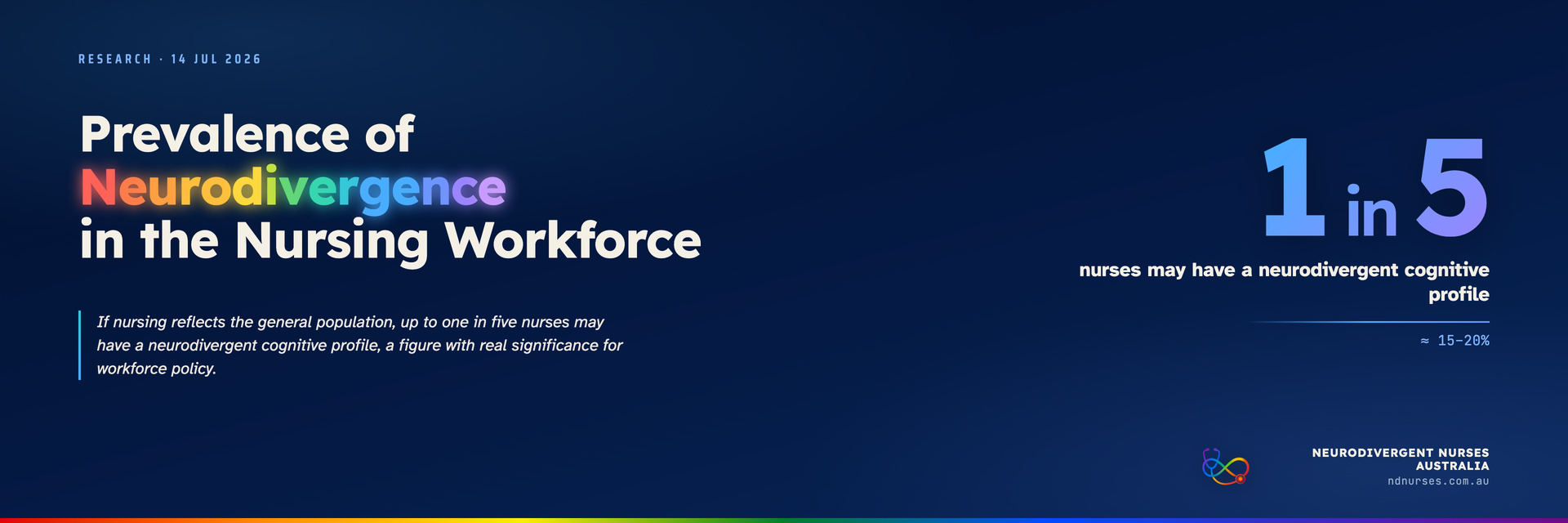
In the general working population, prevalence estimates for neurodivergence sit consistently between 15 and 20 per cent (Doyle, 2020; Azar & Taha, 2025). If nursing reflects that distribution — and there is no robust evidence that it does not — then up to one in five nurses may have a neurodivergent cognitive profile. That figure, while approximate, has real significance for workforce policy. A registered nursing workforce of approximately 300,000 in Australia, if it mirrors the general population, could include between 45,000 and 60,000 neurodivergent practitioners.
Nursing-specific data remains sparse. Hedlund and Jordal (2025) conducted a cross-sectional study of nurses with ADHD and autism in Sweden, finding that this group reported less supportive work environments and poorer psychological wellbeing than neurotypical colleagues — while also noting the absence of systematic data on how many neurodivergent nurses are employed in healthcare settings. Burns (2026) has called for the profession to engage more seriously with neurodiversity in nursing, describing the evidence base as early and uneven. Consistent, field-specific prevalence data does not yet exist for the Australian nursing workforce.
Why Figures Are Likely an Underestimate
Several mechanisms converge to suppress neurodivergence figures in the nursing workforce. The disclosure paradox — where receiving support requires disclosing a neurodivergent cognitive profile, but disclosure carries professional risk in environments that still associate neurodivergence with deficit — actively discourages self-identification. Research on ableism within healthcare professions has documented discrimination against health professionals with disabilities across career progression, professional development, and initial employment (Lindsay et al., 2023). That pattern shapes not only what practitioners tell their managers, but what they report on workforce surveys.
Late diagnosis is a second structural factor. The diagnostic criteria for autism and ADHD were normed on male, often childhood, presentations. Many nurses — particularly women, and those who developed robust adaptive strategies earlier in their lives — may not have received a formal assessment, and may not recognise a neurodivergent cognitive profile in their own experience. A practitioner who has spent years building systems for managing sensory load, complex sequencing, or rapid task-switching is unlikely to identify as neurodivergent on an employer survey without a prior diagnosis.
Accurate prevalence data would inform staffing models, education design, and the resourcing of adjustments. Without it, health services cannot know the scale of what is already there. For nurses navigating the practical dimensions of disclosure, Neurodivergent Nurses and Disclosure: What You Are Legally Required to Tell Your Employer — and What You Are Not sets out the legal framework. The compounding relationship between unrecognised neurodivergent cognitive profiles and burnout is examined in Burnout and Moral Injury in Neurodivergent Nurses: Understanding the Compounding Risks. For those who received a diagnosis mid-career, Late Diagnosis of Neurodivergence: Identity, Practice, and What Comes Next addresses the specific complexity of navigating that transition in a clinical context.
References
Azar, N. G., & Taha, A. A. (2025). Embracing neurodiversity in the nursing workforce. AJN, American Journal of Nursing, 125(1), 18–19. https://doi.org/10.1097/01.naj.0001094684.03544.03
Burns, K. (2026). Neurodiversity in nursing: time to talk about this? Journal of Clinical Nursing, 35(6), 2579–2580. https://doi.org/10.1111/jocn.70240
Doyle, N. (2020). Neurodiversity at work: a biopsychosocial model and the impact on working adults. British Medical Bulletin, 135(1), 108–125. https://doi.org/10.1093/bmb/ldaa021
Hedlund, Å., & Jordal, M. (2025). What about neurodiversity among nurses? A cross-sectional exploration of work environment and health among nurses with ADHD and/or autism. WORK: A Journal of Prevention, Assessment & Rehabilitation, 80(3), 1287–1295. https://doi.org/10.1177/10519815241289852
Lindsay, S., Fuentes, K., Ragunathan, S., Lamaj, L., & Dyson, J. (2023). Ableism within health care professions: a systematic review of the experiences and impact of discrimination against health care providers with disabilities. Disability and Rehabilitation, 45(17), 2715–2731. https://doi.org/10.1080/09638288.2022.2107086
This post contains general information only and does not constitute legal, medical, or professional advice. Information is accurate to the best of the author’s knowledge at the time of publication. For advice specific to your situation, please consult an appropriately qualified professional.