
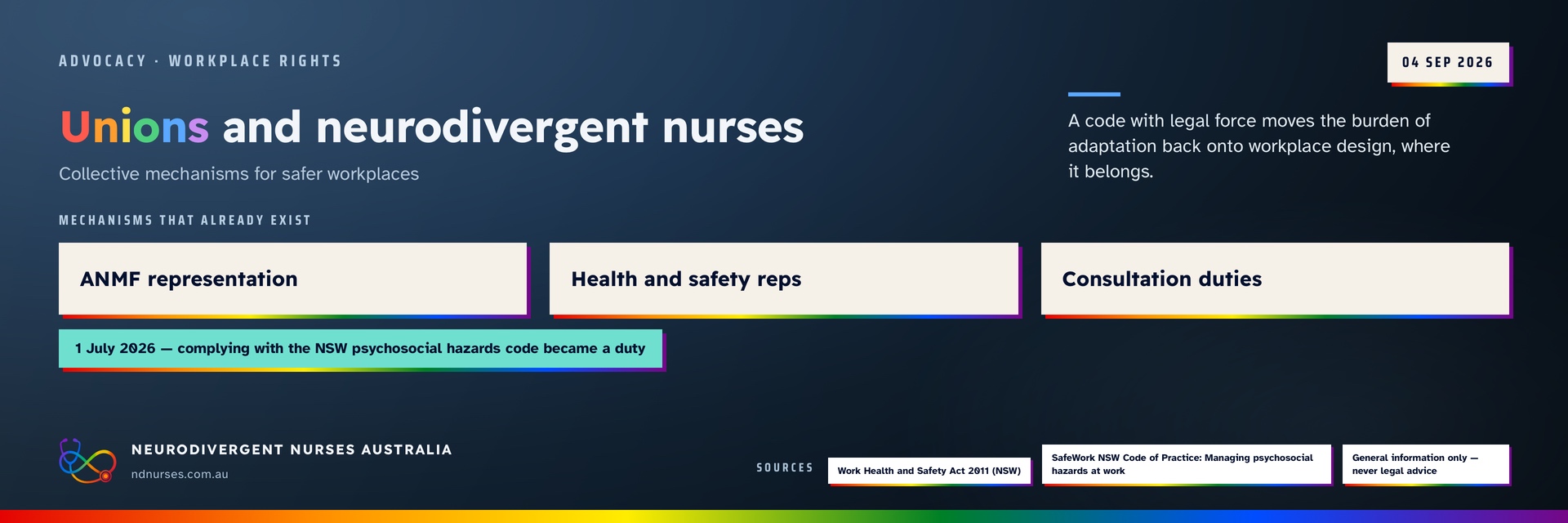
Unions and neurodivergent nurses: collective mechanisms for safer workplaces
Neurodivergent nurses contribute pattern recognition, sustained attention and empathy grounded in lived experience to clinical teams. Whether those contributions are sustained across a career depends less on individual effort than on the structures around the work: rosters, workloads, sensory environments, and how concerns are handled when they are raised. Most of those structures are set collectively. That is where unions, and the industrial and safety mechanisms they give nurses access to, become directly relevant to neurodiversity in the workforce.
The mechanisms that already exist
The Australian Nursing and Midwifery Federation (ANMF) is the registered union for nurses, midwives and carers in Australia, and its state and territory branches represent members in workplace matters. Under the Fair Work Act 2009 (Cth), general protections cover workplace rights, including belonging to a union and taking part in lawful industrial activity. Under the Work Health and Safety Act 2011 (NSW) and its counterparts in other jurisdictions, workers can be represented by elected health and safety representatives, and employers have duties to consult workers on matters affecting their health and safety. Psychosocial hazards, which include high job demands, low support, poor management of organisational change and workplace bullying, sit inside that safety framework. Safe Work Australia’s model Code of Practice on managing psychosocial hazards at work (2022) describes them as hazards to be identified and controlled like any other. Ableism in the health professions is well documented (Lindsay et al., 2023), and studies with nurses with ADHD and autism have begun to map how work environment relates to health in this group (Hedlund & Jordal, 2025), which places neurodiversity squarely within that hazard conversation. Union publications have started engaging with the topic directly, including recent coverage in the ANMF’s journal by the federation’s Federal Vice President (Tiefholz, 2026).
What changed in New South Wales on 1 July 2026
In New South Wales, SafeWork NSW’s Code of Practice: Managing psychosocial hazards at work is an approved code under section 274 of the Work Health and Safety Act 2011 (NSW). SafeWork NSW has advised that from 1 July 2026 it became a duty to comply with an approved code of practice, or to provide a standard of health and safety equivalent to or higher than the code. In practical terms, guidance that was previously advisory now carries legal weight in that state. For nurses with neurodivergent cognitive profiles, the hazards named in the code, including high demands, low support and poor consultation on change, are often the same conditions that make clinical work hardest, and the adaptive labour of absorbing those conditions has historically fallen on individual nurses. A code with legal force moves more of that burden back onto workplace design, where it belongs. The position differs between jurisdictions: each state and territory regulates psychosocial hazards through its own instruments, so the rules that apply depend on where a nurse works and who employs them. This post describes what the law is, and it does not say what any individual should do. For advice about a specific situation, nurses can speak with their ANMF branch, their professional indemnity insurer, or an employment lawyer.
Collective mechanisms will never resolve every barrier on their own, and union engagement with neurodiversity is still developing. They remain one of the few levers that change conditions for a whole workforce at once rather than one adjustment request at a time. The legal foundations of individual adjustments are set out in our post on what Australian law actually requires. Protections for nurses who raise concerns are covered in whistleblowing in healthcare, and the safety framing of mistreatment is discussed in bullying and neurodivergent nurses.
References
Hedlund, Å., & Jordal, M. (2025). What about neurodiversity among nurses? A cross-sectional exploration of work environment and health among nurses with ADHD and/or autism. WORK: A Journal of Prevention, Assessment & Rehabilitation, 80(3), 1287–1295. https://doi.org/10.1177/10519815241289852
Lindsay, S., Fuentes, K., Ragunathan, S., Lamaj, L., & Dyson, J. (2023). Ableism within health care professions: a systematic review of the experiences and impact of discrimination against health care providers with disabilities. Disability and Rehabilitation, 45(17), 2715–2731. https://doi.org/10.1080/09638288.2022.2107086
Safe Work Australia (2022). Model Code of Practice: Managing psychosocial hazards at work. Australian Government.
SafeWork NSW (2021, as amended). Code of Practice: Managing psychosocial hazards at work. NSW Government. https://www.safework.nsw.gov.au/resource-library/list-of-all-codes-of-practice/codes-of-practice/managing-psychosocial-hazards-at-work
Tiefholz, A. S. (2026). Are we paying attention to Neurodiversity? Australian Nursing & Midwifery Journal. https://anmj.org.au/are-we-paying-attention-to-neurodiversity/
Fair Work Act 2009 (Cth). https://www.legislation.gov.au/C2009A00028/latest
Work Health and Safety Act 2011 (NSW). https://legislation.nsw.gov.au/view/html/inforce/current/act-2011-010
This post contains general information only and does not constitute legal, medical, or professional advice. Information is accurate to the best of the author’s knowledge at the time of publication. For advice specific to your situation, please consult an appropriately qualified professional.